What is Product-Led Growth? The Zero-Sales-Team Strategy
Product-Led Growth (PLG) is a business strategy where the product itself drives customer acquisition, conversion, and expansion. Instead of hiring salespeople to convince prospects, you build a product so good that users sell it for you.
Slack, Figma, Notion, Zoom, Calendly — the biggest software successes of the last decade all used PLG. And in 2026, AI is making PLG more powerful than ever.
PLG vs. Sales-Led Growth
| Aspect | Product-Led Growth | Sales-Led Growth |
|---|---|---|
| Acquisition | User signs up, tries product | Sales rep qualifies and demos |
| Conversion | User upgrades when they hit value | Sales rep closes the deal |
| Expansion | Usage-based upgrades, team invites | Account manager upsells |
| Cost | Low CAC, high efficiency | High CAC, expensive team |
| Speed | Users convert in hours/days | Sales cycles of weeks/months |
| Scale | Viral, compounds naturally | Linear, requires more reps |
The fundamental difference: PLG lets the product do the selling. Sales-led growth requires humans at every step.
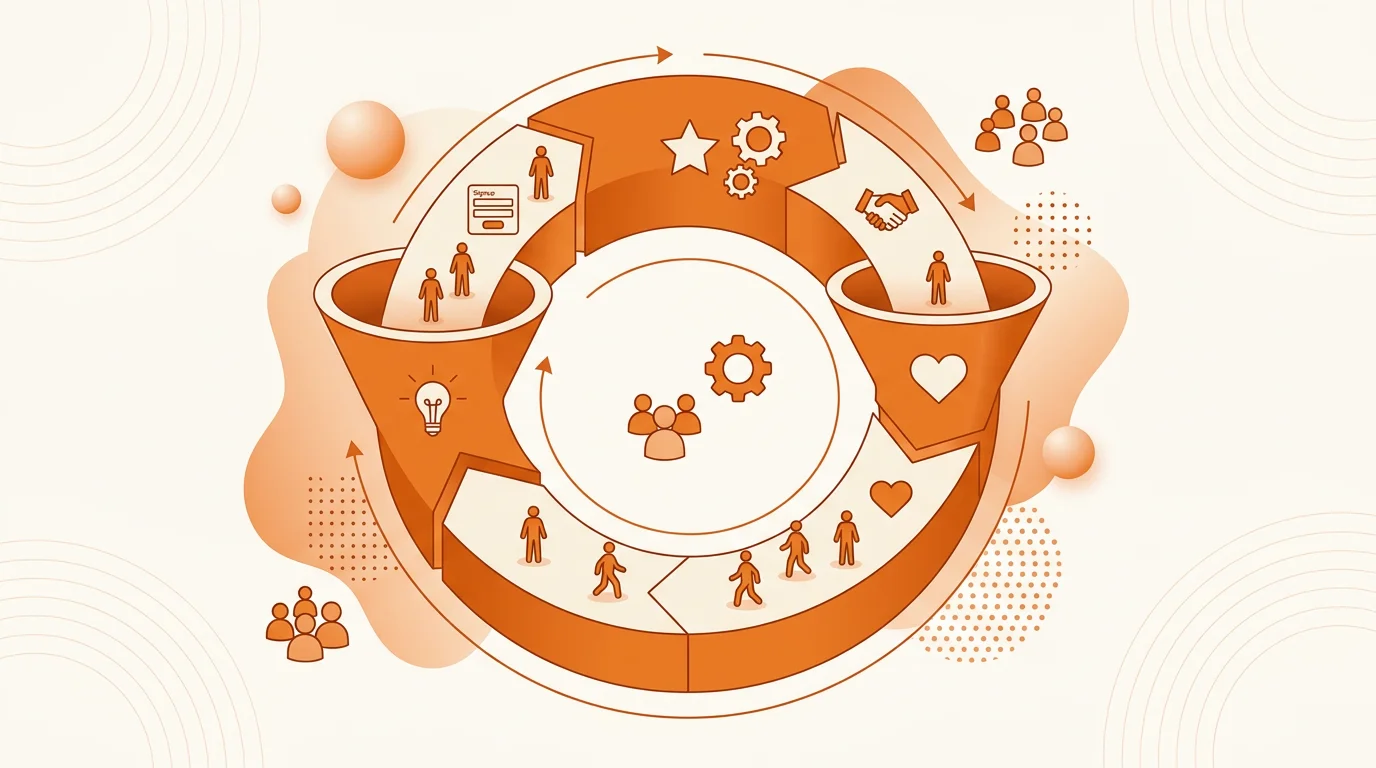
The PLG Flywheel
PLG isn't just "offer a free trial." It's a complete go-to-market strategy built on a flywheel:
1. Attract — Users discover your product through word of mouth, SEO, or viral loops. The marketing focuses on the product experience, not sales messaging.
2. Activate — New users experience the core value quickly. The faster someone has an "aha moment," the more likely they convert. Great PLG products deliver value in minutes, not days.
3. Engage — Users build habits around the product. Usage increases. Data accumulates. Switching costs grow naturally (not artificially).
4. Monetize — Users hit natural upgrade triggers: more storage, more team members, advanced features. The upgrade feels like unlocking more value, not paying a toll.
5. Expand — Happy users invite teammates. Teams invite other teams. One user becomes an organization-wide deployment. This is where PLG compounds.
Why PLG Works So Well
Lower Customer Acquisition Cost
PLG companies spend 50-80% less on customer acquisition than sales-led competitors. The product markets itself through:
- Viral loops: User invites colleague, colleague invites their team
- Network effects: Product becomes more valuable as more people use it
- Organic search: Product-focused content ranks for high-intent keywords
- Word of mouth: Delightful products get recommended naturally
Faster Revenue Growth
Because there's no sales cycle bottleneck, PLG companies can grow faster:
- Users convert 24/7 without waiting for a sales rep
- International expansion happens automatically (no need for local sales teams)
- Self-serve upgrades don't require contract negotiations
Better Unit Economics
PLG companies typically have:
- Higher gross margins: Less human involvement in sales and onboarding
- Lower churn: Users who chose the product themselves are more committed
- Higher LTV:CAC ratios: Lower acquisition cost + higher retention = better unit economics
- Negative churn: Expansion revenue from growing teams exceeds lost revenue
PLG Metrics That Matter
Standard SaaS metrics apply, but PLG companies track additional product-focused metrics:
| Metric | What It Measures | Target |
|---|---|---|
| Time to Value | Minutes from signup to "aha moment" | < 5 minutes |
| Activation Rate | % of signups who reach core value | > 40% |
| Free-to-Paid Conversion | % of free users who upgrade | 3-8% |
| Viral Coefficient | New users generated per existing user | > 1.0 |
| Product-Qualified Leads | Users showing buying signals through usage | Growing |
| Expansion Revenue % | Revenue from upgrades vs. new sales | > 30% |
How AI Supercharges PLG
AI is the greatest force multiplier for PLG since the cloud. Here's why:
AI-Powered Onboarding
Instead of static tutorials, AI guides each user through a personalized onboarding flow. It observes what the user is trying to accomplish and suggests the fastest path to value. Time-to-value drops from days to minutes.
AI as the Product
Many PLG products in 2026 are AI-native. The AI is the core value. Users get immediate results from AI features, creating instant "aha moments" that drive activation and conversion.
Zero-Employee PLG
The ultimate PLG company has no sales team, no support team, and no onboarding team — because the AI handles all of it. AI agents manage customer interactions, product improvements, and growth loops autonomously.
This is the model powering many companies on EvolC: PLG products that are not only sold without salespeople but operated without employees.
Building a PLG Strategy
If you're building a SaaS product, here's how to implement PLG:
Step 1: Define your "aha moment"
What's the single action that makes users say "I need this"? For Slack, it was sending a message and getting a response. For Dropbox, it was accessing a file from another device.
Step 2: Remove friction before the aha moment
Every form field, every required step, every loading screen between signup and the aha moment reduces activation. Cut ruthlessly.
Step 3: Build natural upgrade triggers
Don't gate core value behind a paywall. Instead, let users hit natural limits: storage caps, team size limits, advanced features they need as they grow.
Step 4: Create viral loops
Build sharing, collaboration, or invitation mechanics into the core product experience. The product should naturally spread from one user to many.
Step 5: Instrument everything
Track activation, engagement, and conversion meticulously. Use product analytics to find where users drop off and optimize continuously.
PLG for Small and Micro SaaS
PLG isn't just for venture-backed companies. It's arguably even more important for micro SaaS businesses. If you're a solo founder, you can't afford a sales team. PLG lets you grow without one.
Combined with AI operations, a PLG micro SaaS can generate significant MRR with zero employees and near-zero marginal costs. That's a business worth investing in.