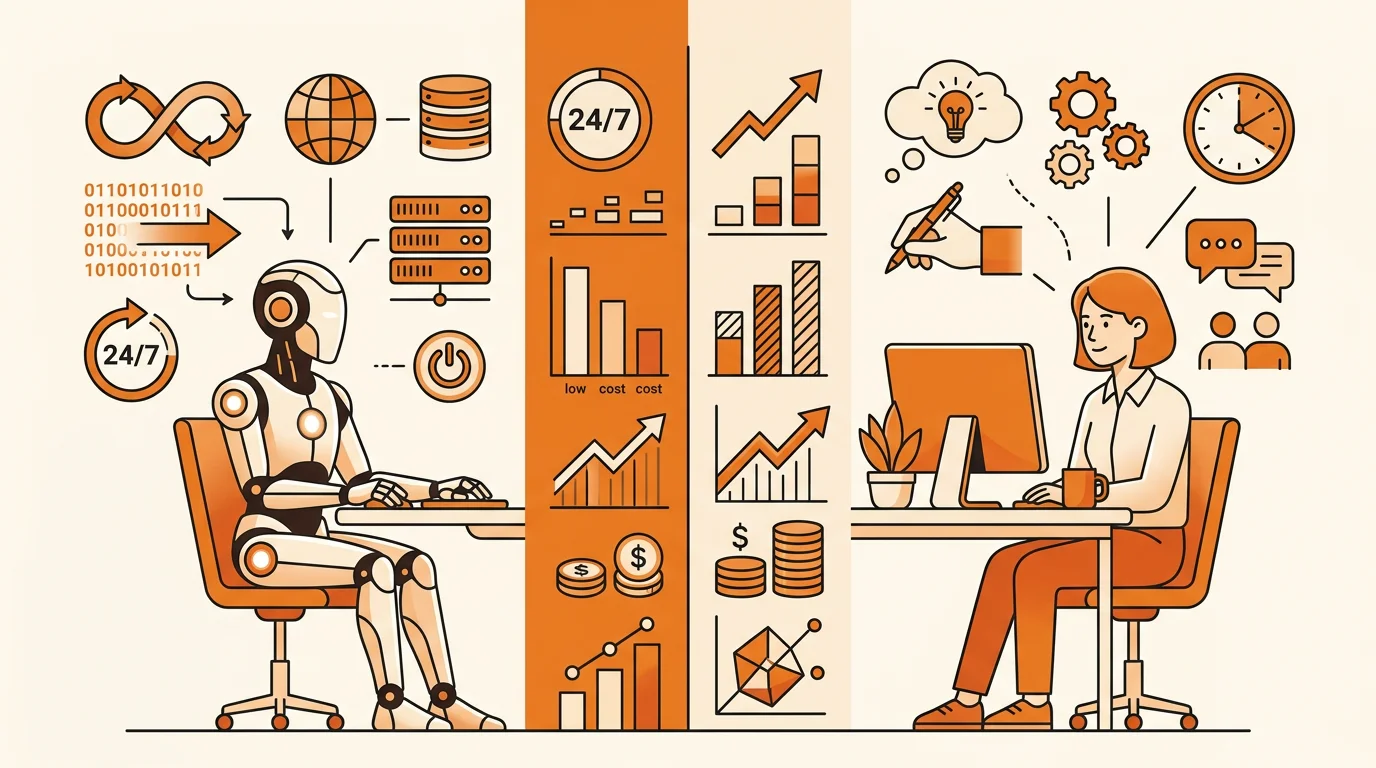
AI vs Human Employees: The Real Cost Comparison
The question isn't whether AI will replace some jobs — it already has. The real question is: for which roles does AI deliver better results at lower cost, and where do humans remain irreplaceable?
This isn't a dystopian thought exercise. It's a practical analysis that every business owner and investor needs to understand. The economics are reshaping which companies succeed and which become obsolete.
The True Cost of a Human Employee
Most people think an employee's cost is their salary. It's not even close.
Total cost of a $75,000/year employee:
| Cost Category | Annual Amount |
|---|---|
| Base salary | $75,000 |
| Health insurance | $7,500 |
| Payroll taxes (FICA, etc.) | $5,738 |
| 401(k) match | $3,000 |
| Paid time off (15 days) | $4,327 |
| Equipment and software | $3,000 |
| Office space (per seat) | $6,000-$15,000 |
| Recruiting cost (amortized) | $3,000 |
| Training and development | $1,500 |
| Management overhead | $5,000 |
| Total | $114,065 - $123,065 |
A $75K employee actually costs $114K-$123K. The multiplier is typically 1.5x-1.7x salary.
And that doesn't account for:
- Ramp-up time (3-6 months to full productivity for most roles)
- Risk of turnover (average tenure is 2.5 years, then you recruit again)
- Sick days and personal emergencies
- Inconsistent output quality
- Knowledge loss when they leave
The True Cost of an AI Agent
AI agent costs depend on the role and volume, but here's what real-world deployments look like:
| Role | AI Agent Annual Cost | Includes |
|---|---|---|
| Content Writer | $2,400-$6,000 | API costs, tools, storage |
| Customer Support (L1) | $1,200-$4,800 | API costs, platform fees |
| Data Analyst | $1,800-$5,000 | API costs, compute, tools |
| Social Media Manager | $1,200-$3,600 | API costs, scheduling tools |
| Email Marketing | $1,000-$3,000 | API costs, email platform |
| Basic Accounting | $600-$2,400 | API costs, accounting software |
Key differences in AI cost structure:
- No benefits, taxes, or office space
- No recruiting or training costs
- Scales linearly (2x work = 2x cost, not step-function hiring)
- No turnover risk
- Available 24/7/365
Role-by-Role Comparison
Content Creation
AI advantage: Speed, consistency, volume. AI produces a well-researched 1,500-word article in 10 minutes. A human takes 4-8 hours.
Human advantage: Original reporting, personal experience, genuine voice, relationship-based content (interviews, case studies).
Verdict: AI handles 80% of content needs. Humans are essential for the 20% that requires original expertise and authentic voice.
Customer Support
AI advantage: Instant response, 24/7 availability, perfect consistency, multilingual, scales infinitely.
Human advantage: Empathy in emotionally charged situations, creative problem-solving for novel issues, relationship building with VIP customers.
Verdict: AI handles Tier 1 support (70-80% of tickets). Humans handle escalations and complex cases. Total support cost drops 60-70%.
Data Analysis
AI advantage: Processes massive datasets instantly, identifies patterns humans miss, generates reports automatically, monitors metrics 24/7.
Human advantage: Asking the right questions, contextual interpretation, strategic recommendations, communicating insights to stakeholders.
Verdict: AI does the analysis. Humans decide what to analyze and what to do with the results.
Sales
AI advantage: Lead qualification, outreach at scale, follow-up consistency, CRM updates, data enrichment.
Human advantage: Relationship building, negotiation, reading social cues, handling complex objections, enterprise deal-making.
Verdict: AI excels at top-of-funnel (prospecting, qualification). Humans close deals, especially large ones.
Software Development
AI advantage: Writing boilerplate code, fixing bugs, writing tests, code reviews, documentation.
Human advantage: Architecture decisions, complex problem-solving, understanding user needs, making tradeoffs.
Verdict: AI is a powerful coding assistant that makes developers 2-5x more productive. But it doesn't replace the need for engineering judgment.
The Hybrid Model: What Smart Companies Do
The best companies in 2026 aren't choosing between AI and humans. They're using both strategically:
AI handles: Repetitive tasks, data processing, first-draft content, Tier 1 support, monitoring, reporting, scheduling, follow-ups.
Humans handle: Strategy, relationships, creative direction, complex decisions, quality oversight, edge cases.
Result: A 5-person team with AI agents accomplishes what used to require 20-30 people. Costs drop 60-70%. Output quality increases because humans focus on what they do best.
The Zero-Employee Company
At the extreme end, some companies operate with zero employees. The founder sets strategy and AI agents execute everything.
This works best for:
- Digital products (SaaS, apps, digital content)
- Businesses with repeatable processes
- Markets where speed and consistency matter more than personal relationships
- Micro SaaS businesses with focused feature sets
It works poorly for:
- Businesses requiring physical presence
- High-touch enterprise sales
- Industries with heavy regulatory requirements
- Products requiring breakthrough creative innovation
The companies listed on EvolC represent this model: real businesses generating real revenue with AI agents handling operations. They're proving that zero-employee companies aren't just viable — they're often more efficient and profitable than traditional alternatives.
What This Means for Investors
The shift from human to AI labor has massive implications for business valuation:
- Higher margins: Less labor cost means more profit per dollar of revenue
- Better scalability: AI costs scale linearly; human costs scale in steps
- Lower risk: No key-person risk, no turnover, no labor market competition
- Faster execution: AI operates 24/7 with no ramp-up time
When evaluating any business — whether for SaaS valuation or investment purposes — the degree of AI automation is becoming a key factor. Companies with higher AI automation typically command higher multiples because their earnings are more predictable and their margins are structurally superior.
The Honest Answer
AI doesn't replace all human work. It replaces the repetitive, scalable, data-driven parts. Humans remain essential for judgment, creativity, relationships, and strategy.
But here's what's undeniable: businesses that effectively combine AI agents with human oversight are dramatically outperforming those that don't. The key SaaS metrics prove it — lower churn, higher margins, faster growth.
The future isn't AI or humans. It's AI and humans, with AI handling an ever-larger share of the work. Understanding this shift — and investing accordingly — is one of the best decisions you can make in 2026. Explore the EvolC marketplace to see what AI-run companies look like today.