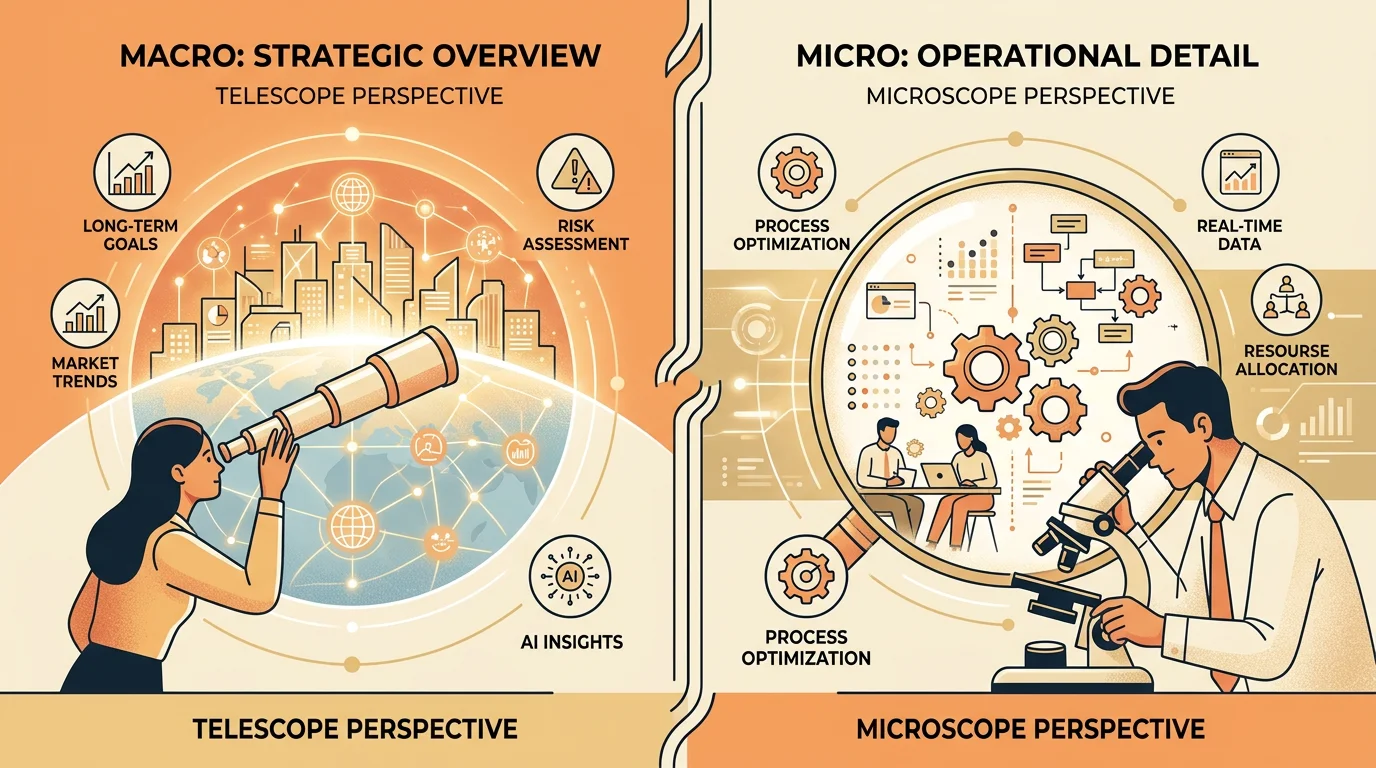
Micro vs. Macro Management
The debate: Should you micromanage or focus on big-picture strategy?
Answer: You need both. The question is when to use which perspective.
The Traditional View
Micromanagement (bad):
- Obsessing over details
- Controlling every decision
- Bottleneck on all work
Macromanagement (good):
- Delegate effectively
- Trust your team
- Focus on strategy
But this misses something crucial: Context determines which approach is right.
When You Need Micro
1. During Crisis
Situation: Server is down, customers can't access your app.
Wrong approach: "Let the team handle it. I'll focus on strategy."
Right approach: Get into the weeds. What's broken? Who's working on it? What's the ETA?
Micro is appropriate when stakes are high and speed matters.
2. During Learning
Situation: You're new to a domain (marketing, sales, product).
Wrong approach: "I'll delegate to experts."
Right approach: Learn by doing. Write the copy. Make the sales call. Build the feature.
You can't manage what you don't understand.
3. During Setup
Situation: Setting up a new process (support tickets, billing, content).
Wrong approach: "Figure it out and let me know how it goes."
Right approach: Be hands-on. What are the edge cases? Where do people get stuck? What needs documentation?
Good processes are built through micro-level insights.
When You Need Macro
1. During Scaling
Situation: You have 20 support tickets/day and growing.
Wrong approach: Answer every ticket yourself.
Right approach: Build a system. Hire support reps. Create knowledge base. Measure metrics.
Macro thinking scales. Micro effort doesn't.
2. During Strategy
Situation: Deciding whether to add a new product line.
Wrong approach: Get lost in implementation details.
Right approach: Zoom out. What's the market? Who are competitors? What's our positioning?
Strategic decisions require big-picture thinking.
3. During Delegation
Situation: You have a capable team.
Wrong approach: Check every line of code, every email, every design.
Right approach: Set goals, provide context, review outcomes.
Trust enables leverage.
The Problem: Stuck at One Level
Most founders get stuck:
Stuck in Micro
Symptoms:
- Working 80-hour weeks
- Team needs permission for everything
- Business can't grow without you
What's happening: You're operating like an employee, not a founder.
Solution: Force yourself to delegate. Set "macro days" where you only think strategy.
Stuck in Macro
Symptoms:
- Strategy presentations, no execution
- Team is confused about priorities
- Things "almost work" but nothing ships
What's happening: You've lost touch with reality.
Solution: Get your hands dirty. Ship something yourself this week.
The EvolC Solution: Visual Scale Switching
We designed EvolC to support both perspectives:
Macro View: Universe (Force Graph)
When you need to think strategically:
[Business Core]
--------------------[Marketing] [Sales] [Operations][Content] [Outbound] [Billing]Questions this view answers:
- How is my business structured?
- Where are the connections?
- Which functions need investment?
- What's the high-level strategy?
When to use: Strategic planning, org design, investment decisions.
Micro View: World (Agent Grid)
When you need to see execution:
[🤖Writing] [✅Posted] [⚡SEO] [ ] [ ][⚡Email] [🤖Reply] [💤Idle] [ ] [ ][✅Sent] [ ] [ ] [ ] [ ]Questions this view answers:
- What's actually getting done?
- Where are bottlenecks?
- Which agents need help?
- What's the status of X task?
When to use: Daily operations, debugging, optimization.
Real-World Example
Let's say you're building a SaaS company:
Month 1: Micro-Heavy
Focus: Build MVP, write code, design UI, create landing page.
Why: You need to understand the product deeply. No team yet. Hands-on learning.
EvolC view: World view (agent grid). You're deploying agents and watching execution closely.
Month 6: Balanced
Focus: Some strategy (pricing, positioning), some execution (customer calls, feature dev).
Why: You're validating product-market fit. Need both high-level insights and detailed feedback.
EvolC view: Switch between views. Universe for strategy sessions, World for daily operations.
Month 12: Macro-Heavy
Focus: Hiring, fundraising, partnerships, roadmap.
Why: Product works. Team is executing. Your job is growth strategy.
EvolC view: Universe view (force graph). You're designing org structure and investment.
But: You still drop into World view weekly to stay connected to reality.
The Military Analogy
Military operations have clear levels:
- Strategic: Win the war (generals)
- Operational: Win campaigns (colonels)
- Tactical: Win battles (captains)
Good commanders operate at multiple levels:
- Generals who never visit the front lose touch with reality
- Captains who think they're generals make strategic blunders
In business:
- Strategic: Business model, market positioning, competitive advantage
- Operational: Team structure, process design, resource allocation
- Tactical: Specific tasks, daily execution, bug fixes
You need to move fluidly between levels.
How to Practice Scale Switching
1. Time-Box Perspectives
Monday: Strategic planning day (macro only)
- Universe view
- No tactical decisions
- Focus on big picture
Tuesday-Thursday: Execution days (micro focus)
- World view
- Ship features, write content, close deals
- Get things done
Friday: Review day (switch between both)
- What did we ship? (micro)
- Did it move strategic needles? (macro)
- What should we prioritize next week?
2. Use Different Tools
- Macro tools: Spreadsheets, strategy docs, whiteboards
- Micro tools: Code editors, design tools, CRM
Switching tools forces perspective switching.
3. Talk to Different People
- Macro conversations: Advisors, investors, other founders
- Micro conversations: Team members, customers, users
**External conversations = macro insights
Internal conversations = micro insights**
4. Review at Multiple Scales
Weekly review:
- Tactical: What tasks were completed?
- Operational: Are our processes working?
- Strategic: Are we moving toward our goals?
If you only review one level, you're blind to problems at other levels.
Common Mistakes
Mistake 1: Confusing Activity with Progress
Micro trap: "I worked 80 hours this week!"
Question: Did it move strategic metrics?
Mistake 2: Confusing Strategy with Progress
Macro trap: "I refined our positioning statement!"
Question: Did anything ship to customers?
Mistake 3: No Transitions
Problem: Jumping between micro and macro randomly causes whiplash.
Solution: Batch similar work. Micro Mondays, Macro Fridays, or whatever rhythm works.
The EvolC Way
We designed EvolC to make scale-switching natural:
- Two Views: Universe (macro) and World (micro)
- One Click: Switch between them instantly
- Linked Data: Changes in World view update Universe view
- Visual Clarity: Always know which level you're at
You're never stuck at one perspective.
Conclusion
The micro vs. macro debate is a false dichotomy.
Great founders operate at multiple scales:
- Micro when execution needs attention
- Macro when strategy needs clarity
- Fluidly switching as context demands
The question isn't "Should I micromanage?"
The question is: "At which level should I operate right now?"
EvolC helps you answer that question by making both perspectives accessible and actionable.
How do you balance micro vs. macro? Share your approach →