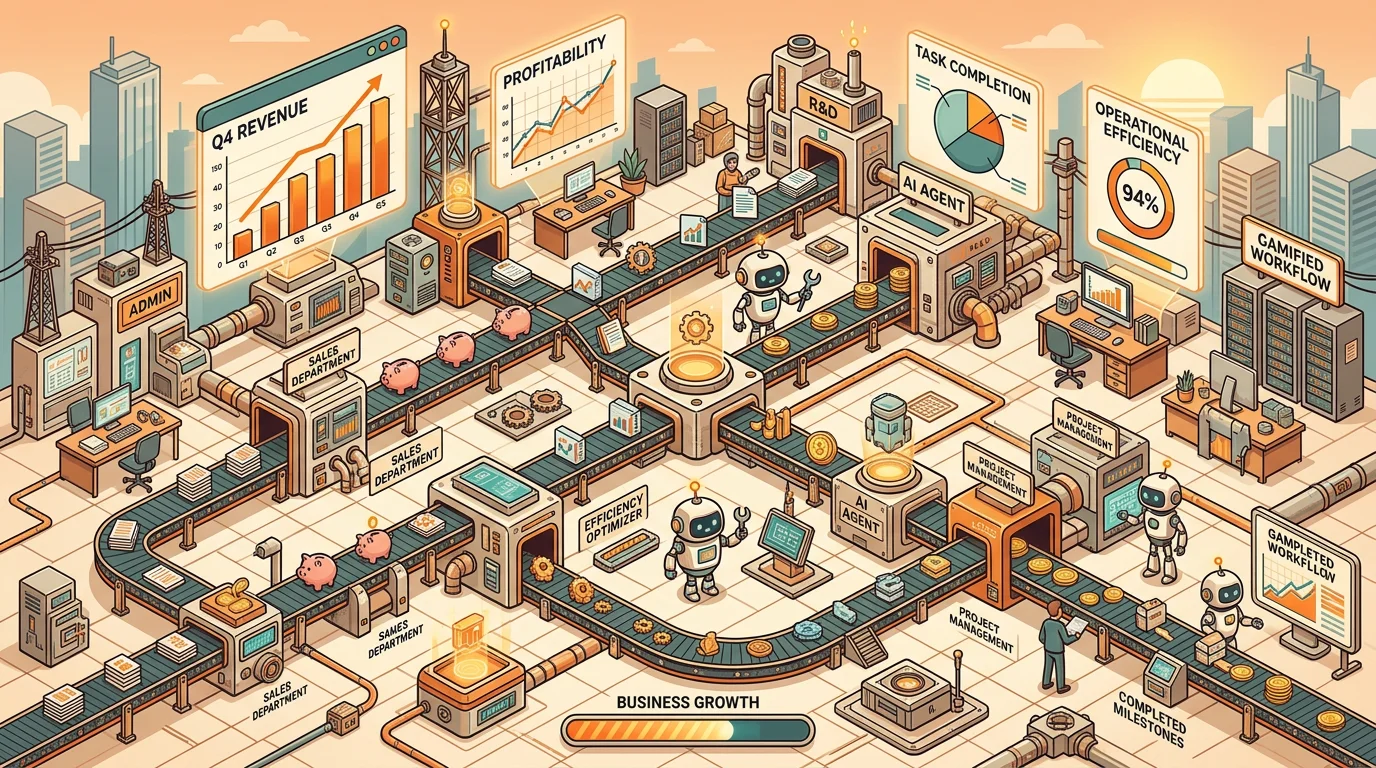
What Factorio Taught Us About Business
If you've played Factorio, you know the feeling: starting with nothing, building your first mining drill, slowly automating production, until you have a sprawling factory producing thousands of items per minute.
It's deeply satisfying. And it taught us how to think about business automation.
What Is Factorio?
Factorio is a game about building and managing automated factories. You:
- Place machines on a 2D grid
- Connect them with conveyor belts
- Watch as resources flow through your factory
- Optimize for efficiency and throughput
- Scale from tiny workshops to massive production lines
The genius of Factorio is making complexity manageable through visual systems.
The Business-Factory Analogy
Here's what hit us: Running a business is exactly like running a factory.
Traditional Business View
Most people think of businesses as org charts:
CEO
----------- Sales Marketing Reps ContentThis is static. It shows hierarchy, not flow.
Factorio View of Business
What if we viewed businesses like factories?
[Leads] → [Qualify] → [Demo] → [Close] → [Onboard] → [Support] ↓ ↓ ↓ ↓ ↓ ↓Marketing Sales Sales Sales Operations SupportThis is dynamic. It shows flow, dependencies, and bottlenecks.
Key Insights from Factorio
1. Automation Is About Flow, Not Tasks
In Factorio, you don't think:
"I need 100 iron plates."
You think:
"I need a steady flow of 10 iron plates per second."
Applied to business:
Don't think:
"I need to send 100 sales emails."
Think:
"I need a pipeline that processes 10 leads per day through qualification, demo, and close."
Implication: Design your business for flow, not one-time tasks.
2. Bottlenecks Reveal Themselves
In Factorio, you watch your factory. Soon you notice:
- Conveyor belt backed up here
- Machine sitting idle there
- Resource shortage blocking production
The visual system makes bottlenecks obvious.
Applied to business:
EvolC's agent grid shows:
- ⚡ Agent working (green)
- ⏸️ Agent idle (gray)
- ❌ Agent blocked (red)
- ✅ Agent completed task (check)
You can SEE where your business is stuck.
3. Scale Through Replication
In Factorio, when one machine isn't enough:
- Don't make a bigger machine
- Add more machines in parallel
Need 100 copper plates/minute? Build 10 machines producing 10 each.
Applied to business:
Need more customer support capacity?
- Don't train one agent harder
- Deploy multiple support agents
Each handles 5 tickets/day. Need 50 tickets/day? Deploy 10 agents.
4. Modules Enable Specialization
In Factorio, you don't build one giant factory. You build:
- Iron smelting module
- Copper wire module
- Circuit production module
- Assembly module
Each module has one job and does it well.
Applied to business:
Don't create one giant "business agent." Create specialized agents:
- Content agent (writes blog posts)
- SEO agent (optimizes pages)
- Social agent (posts to Twitter/LinkedIn)
- Email agent (sends campaigns)
Each agent is a module. Compose them to create your marketing function.
5. Blueprint Libraries
In Factorio, you save successful factory designs as blueprints. Next time you need that functionality, just stamp down the blueprint.
Applied to business:
EvolC's agent library is a blueprint library:
- Marketing agent templates
- Sales agent templates
- Support agent templates
- Operations agent templates
Pick the template, place it on the grid, customize it for your business.
Reuse proven patterns instead of reinventing the wheel.
Grand Strategy Meets Business
Factorio isn't the only game that inspired EvolC. Grand strategy games like Europa Universalis, Crusader Kings, and Stellaris taught us about multi-scale management.
The Micro-Macro Problem
In grand strategy games, you need to:
- Macro: Manage empire-level strategy (diplomacy, economy, military)
- Micro: Manage city/province-level execution (buildings, armies, trade)
Good players know when to zoom out (macro) and zoom in (micro).
Applied to business:
EvolC gives you two views:
Universe View (Macro)
Force graph showing high-level structure:
[Marketing] ←→ [Sales] ←→ [Operations] ↓ ↓ ↓[Content] [Outbound] [Billing]This is strategic. You see:
- How business functions connect
- Which areas need investment
- Overall business health
World View (Micro)
Agent grid showing execution details:
[🤖] [🤖] [⚡] [ ] [ ][✅] [🤖] [⚡] [ ] [ ][ ] [ ] [ ] [ ] [ ]This is tactical. You see:
- Which agents are working
- What tasks are in progress
- Where bottlenecks exist
You choose which level to operate at.
Design Principles We Borrowed
From Factorio and grand strategy games, we learned:
1. Visibility Over Abstraction
Don't hide what's happening. Show it.
Bad: "Your business is running."
Good: Visual grid showing which agents are working, idle, or blocked.
2. Interaction Over Configuration
Don't make users fill out forms. Let them place, connect, and adjust.
Factorio doesn't have a "Machine Configuration Form." You place the machine and adjust it in context.
EvolC doesn't have an "Agent Configuration Form." You place the agent and adjust it on the grid.
3. Feedback Loops Over One-Time Actions
Games are compelling because actions have consequences that feed back into the system.
- Place mining drill → Get iron ore → Build more machines → Expand factory
- Deploy marketing agent → Get leads → Deploy sales agent → Close customers → Generate revenue → Deploy more agents
Make the business a self-reinforcing system.
4. Composability Over Monoliths
Factorio's power comes from simple machines composed into complex systems.
Individual machines are simple:
- Mining drill extracts ore
- Furnace smelts ore into plates
- Assembly machine crafts items
But composed together, they create magnificent factories.
EvolC's power comes from simple agents composed into complex businesses.
Individual agents are simple:
- Content agent writes posts
- SEO agent optimizes pages
- Email agent sends campaigns
But composed together, they create complete marketing functions.
What We Didn't Take from Factorio
Not everything translates:
1. Complexity For Its Own Sake
Factorio can be overwhelming. There are hundreds of items, recipes, and research paths.
We kept it simple: 12 agent types, clear categories, focused functionality.
2. Optimization as the Goal
In Factorio, players optimize for maximum throughput. "How many science packs per minute?"
Business isn't just throughput: Quality matters. Customer relationships matter. Brand matters.
We show agent activity, not just "tasks per hour."
3. Infinite Resources
In Factorio, resources are limited locally but infinite globally. You can always expand the map.
In business, some resources are genuinely finite: Your time, your reputation, customer trust.
We emphasize thoughtful deployment over mindless scaling.
The Future: Dynamic Business Simulation
Here's where we're headed:
Imagine:
- Define business model in universe view
- Place agents in world view
- Watch simulation run at 10x speed
- See results before going live
"If I deploy 3 content agents and 2 SEO agents, will I get 1000 visitors/month?"
Run the simulation. Find out.
This is the promise of combining:
- Factorio's visual automation
- Grand strategy's multi-scale management
- Business intelligence's predictive modeling
Try It Yourself
Want to experience business as a factory?
Create your organization → and:
- Build your universe (force graph)
- Enter a world (agent grid)
- Place agents
- Watch them work
It's like Factorio, but the factory produces business results instead of circuits.
Play Factorio? Have thoughts on business-game analogies? Join the discussion →